
Beyond Sustainability: The Regenerative 7Cs as a Framework for Business Renewal
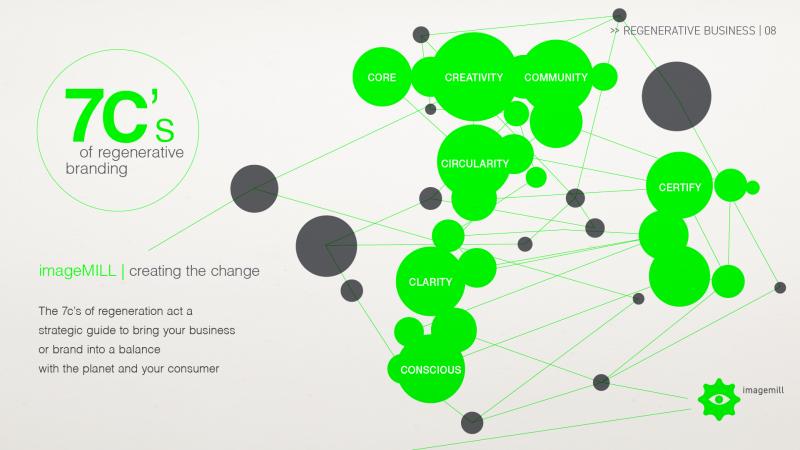
Over the past months, this series has explored the Regenerative 7Cs, a framework developed through imageMILL’s work in branding, systems thinking, sustainability, and regenerative business design. What began with a simple proposition, that sustainability alone is no longer enough, evolved into a broader question:
What would it mean for businesses not only to reduce harm, but to actively contribute to healthier systems?
The result is the Regenerative 7Cs: a practical framework designed to help organisations align purpose, culture, communication, operations, and long-term value creation.
________________________________________
Why Move Beyond Sustainability?
For decades, sustainability focused largely on reducing negative impact: lowering emissions, improving efficiency, and minimising waste. These remain important. But in many cases, “sustaining” current systems is no longer sufficient. Climate instability, biodiversity loss, resource depletion, and social fragmentation all point to the need for something more restorative and adaptive.
Regeneration shifts the focus:
- From extraction to renewal
- From short-term optimisation to long-term resilience
- From isolated actions to systems thinking
- From doing less harm to creating positive value
This is not idealism. It is increasingly becoming a business necessity.
________________________________________
The Regenerative 7Cs
CORE
Align brand with purpose
Ensure values, operations, and decision-making remain coherent across the organisation.
CREATIVITY
Design for transformation
Use imagination, design thinking, and innovation to reshape systems, products, and experiences.
CONNECTION
People · Place · Nature
Build meaningful relationships across communities, ecosystems, and cultures.
CIRCULARITY
Design for regenerative flows
Move beyond linear extraction towards systems that retain value and reduce waste.
CLARITY
Speak truth with simplicity
Communicate honestly, transparently, and without unnecessary complexity.
CONSCIOUS
Develop systems and lifecycle intelligence
Understand how decisions ripple across supply chains, ecosystems, and society.
CERTIFY
Build trust with proof
Use independent standards and verification to strengthen accountability and credibility.
________________________________________
Beyond ESG and the Triple Bottom Line
The Triple Bottom Line introduced an important shift by encouraging businesses to balance People, Planet, and Profit.
The 7Cs build on this foundation, but go further. Where frameworks such as ESG and the SDGs often focus on measurement and reporting, the Regenerative 7Cs focus on the systems, behaviours, and cultural shifts needed to make those outcomes real.
In simple terms:
- The Triple Bottom Line helps measure impact
- ESG helps report impact
- The 7Cs help design and operate organisations capable of delivering meaningful impact
This distinction matters because many businesses now face a credibility gap between ambition and implementation. The challenge is no longer knowing what to improve. It is understanding how to transform systems in practice.
________________________________________
Lessons from Japan and Ireland
Throughout this series, examples from Japan and Ireland revealed that many regenerative principles are not entirely new.
Japan’s traditions of mottainai, omotenashi, genchi genbutsu, and the 24 Sekki demonstrate long-standing awareness of material value, attentiveness, and living in rhythm with natural systems.
Ireland’s storytelling traditions, repair culture, stewardship practices, and community-centred enterprises similarly reflect relational ways of thinking that predate modern sustainability language.
Both cultures remind us that regeneration is not simply technological innovation. It is also cultural memory.
________________________________________
Closing Reflection
The future of business will not be shaped by efficiency alone. It will be shaped by the ability to build trust, adapt to complexity, and contribute positively to the systems that sustain life and society. Regeneration is not a marketing trend or a communications layer added onto existing models. It is a shift in how organisations understand value, responsibility, and success itself.
The Regenerative 7Cs are not intended as a checklist, but as a living framework. One that encourages organisations to think more systemically, act more consciously, and build businesses capable of thriving within ecological and social limits.
The work of regeneration is ongoing. But the direction is becoming increasingly clear.
________________________________________
Byline
Written by Rick Grehan, IJCC Vice President and Sustainability Committee Manager, founder of imageMILL.