
Featured Article: The Regenerative 7Cs | Connection
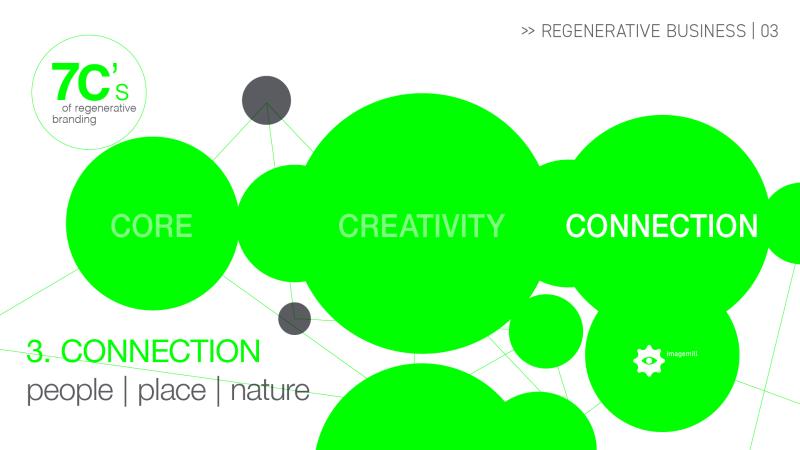
CONNECTION & COMMUNITY: People | Place | Nature
After CORE and CREATIVITY, the next step in regenerative business is CONNECTION & COMMUNITY. This is where purpose and design meet people, place, and culture.
Regenerative brands do not see people only as customers. They see them as participants, collaborators, and part of a wider social and ecological system. Without genuine connection, there is no trust. Without trust, there is no long-term business.
________________________________________
Why Community Matters in Regeneration
Modern business has become efficient but disconnected. Globalisation and digitalisation have scaled reach, but often at the cost of depth. Advertising replaces conversation. Metrics replace meaning. Community becomes an audience rather than a relationship.
Regenerative brands work in the opposite direction. They focus on belonging, not broadcasting. They invest in relationships that are social, cultural, and ecological, not just transactional.
This approach creates:
- Local trust and cultural relevance
- Stronger loyalty and advocacy
- Deeper understanding between organisations and society
Community is not something you “build” around a brand. It is something you participate in.
________________________________________
Connection Beyond the Human
Connection is not only about people. It is also about place and nature.
We are living through an era of deep disconnection from the natural world, from each other, and often from ourselves. Nature offers a path back. When people reconnect with natural systems, they begin to sense interdependence rather than separation. From that awareness, empathy grows, and with it, responsibility.
For businesses, this matters. Understanding your impact on land, water, ecosystems, and communities changes how decisions are made. It encourages circular thinking and long-term stewardship rather than short-term extraction.
________________________________________
Cultural Roots in Japan and Ireland
Japan and Ireland both carry deep traditions of community and connection.
In Japan, connection has long been understood as something that unfolds through attention, timing, and care. Practices such as Nemawashi, the act of laying relational groundwork before action, and Omotenashi, the spirit of anticipatory hospitality, were not isolated behaviours but expressions of a wider system of awareness. This sensitivity is also reflected in the 24 Sekki, the ancient calendar that divided the year into finely observed seasonal phases, guiding communities to act in rhythm with natural change. Together, these practices fostered shared understanding, prevented overreach, and reinforced trust between people, place, and time. For regenerative businesses, the lesson is clear: deep connection is built not through constant visibility, but through attentiveness, respect for context, and thoughtful response.
In Ireland, connection has often been sustained through storytelling and shared experience. Organisations such as the Burrenbeo Trust show how engagement with landscape, history, and seasonal change can reconnect people to place and to each other through participation rather than promotion. Similarly, brands like VOYA root their identity in ancestral practices of seaweed harvesting and bathing, allowing nature and tradition to shape not only products, but narrative continuity. These examples remind us that community is not built through reach or frequency, but through meaning, memory, and presence over time.
These traditions show that regeneration is not new. What is new is the scale of disconnection driven by homogenised global thinking. Community-centred brands offer a way back.
________________________________________
Community as a Branding Practice
From a branding perspective, connection shapes how and where a brand shows up. In regenerative business, branding is not about reach or repetition, but about relationship. Storytelling matters here, not as surface-level content, but as a way of maintaining meaning, memory, and continuity across people, place, and time.
Regenerative brands do not invent stories. They listen for the ones already present within their organisation, their partners, and the environments they depend on, and allow those voices to shape how the brand is expressed.
In practice, this changes behaviour.
Regenerative brands:
- Choose channels that encourage dialogue, not just exposure
- Listen before speaking
- Share ownership of stories and outcomes
- Show up consistently, not episodically
Without connection, there is no understanding. Without understanding, branding becomes noise.
________________________________________
Putting Community & Connection into Practice
Three questions to ask
- Do we treat people as audiences or participants?
- Are we connected to the social and environmental systems we affect?
- Does our organisation feel like a community internally?
Three starting actions
- Co-create initiatives with local partners or stakeholders
- Design touchpoints that prioritise care and listening
- Create space for teams to reconnect with purpose, place, and each other
________________________________________
Closing Reflection
Regeneration asks us to re-weave relationships that industrial systems have stretched or broken: between people within organisations, between business and society, and between human activity and the natural systems that support it. Connection, in this sense, is not sentiment, but attention, responsibility, and care expressed over time.
When brands cultivate this kind of connection, they do more than grow markets. They build trust, strengthen culture, and create the conditions for resilience and long-term value.
Next month, we explore how these relationships translate into practice with the next C: Circularity.
________________________________________
Written by Rick Grehan, IJCC Board Member and Sustainability Committee Manager, and founder of imageMILL.